<![CDATA[Multiwfn forum / Natural Transition Orbital (NTO) overlap density plots]]> //www.umsyar.com/wfnbbs/viewtopic.php?id=812 The most recent posts in Natural Transition Orbital (NTO) overlap density plots. Mon, 17 Apr 2023 11:33:01 +0000 FluxBB <![CDATA[Re: Natural Transition Orbital (NTO) overlap density plots]]> //www.umsyar.com/wfnbbs/viewtopic.php?pid=3098#p3098

Dear friends,

I found this method in 3.16 section in the manual. Thanks.

dummy@example.com (zmfhtm2045) Mon, 17 Apr 2023 11:33:01 +0000 //www.umsyar.com/wfnbbs/viewtopic.php?pid=3098#p3098
<![CDATA[Natural Transition Orbital (NTO) overlap density plots]]> //www.umsyar.com/wfnbbs/viewtopic.php?pid=3097#p3097

Hello everyone,

I am a newbie in using Multiwfn. Now, I have conducted for TD-DFT calculations with Gaussian, and I am currently working on calculating NTOs for small molecules with donor-acceptor characteristics.

I would like to generate isosurface plots showing the product between NTO(hole) and NTO(electron) as described in the paper (J. Am. Chem. Soc. 2019, 141, 8616-8626) (refer to the attached picture for the center of NTO overlap).

My questions are:

Does Multiwfn support functions for plotting newly defined grids?

If so, how can I generate the density plot for the product between NTO(hole) and NTO(electron))?

Thank you!
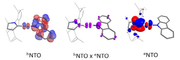
capture.png

dummy@example.com (zmfhtm2045) Mon, 17 Apr 2023 07:37:51 +0000 //www.umsyar.com/wfnbbs/viewtopic.php?pid=3097#p3097
Baidu
map